

Hemimorphite: The Blue Stone of Empathy and Light

Some stones whisper. Hemimorphite practically leans over the table and says, “Hey, maybe take a breath before replying to that text.”
This soft blue mineral has built a loyal following for two very different reasons. Mineral collectors love it because it forms in gorgeous crusts, sprays, and grape-like clusters. Crystal lovers love it because it’s often linked with empathy, gentle communication, emotional clarity, and that clean “light through water” feeling. Science and symbolism meet here in a pretty charming way, like a geology textbook wearing a calming blue scarf.
Hemimorphite is real mineral-world material, not just a pretty pebble with a dramatic backstory. It’s a zinc silicate mineral, and standard mineral references describe it as common in the weathered zones of zinc deposits. Spiritually, people often treat it as a stone for softening emotional edges, speaking with kindness, and bringing compassion into tense moments.
Let’s look at both sides: what hemimorphite actually is, why it’s often blue, what “empathy and light” means in crystal practice, and how to care for it without accidentally treating it like a dishwasher-safe mug. Spoiler: it is not one.

Hemimorphite is a zinc mineral with a very literal name
Hemimorphite’s name comes from an unusual crystal habit. The word refers to crystals with different forms on opposite ends. “Hemi” means half, and “morph” relates to form or shape. In plain English, the two ends of a hemimorphite crystal don’t match. It’s the mineral version of wearing one sneaker and one hiking boot, except somehow elegant.
That crystal feature is called hemimorphism. You don’t need to memorize the term unless you want to sound mysterious at a rock shop. The useful takeaway: hemimorphite isn’t named for its color, energy, or mood. It’s named for a real structural trait that mineralogists can observe.
The basic mineral facts
Hemimorphite is a zinc silicate mineral. That means its natural structure includes zinc, silicon, oxygen, hydrogen, and water. It often forms where oxygen, water, and time have changed zinc-rich rocks near Earth’s surface.
Standard mineral references, including the Handbook of Mineralogy and museum mineral catalogs, commonly describe hemimorphite with these traits:
Trait | What it means in real life |
Mineral family | Zinc silicate |
Common colors | White, colorless, pale blue, blue-green, gray, brownish, or yellowish |
Hardness | About 4.5 to 5 on the Mohs scale |
Luster | Glassy, silky, pearly, or dull depending on the form |
Streak | White |
Usual forms | Crusts, botryoidal masses, sprays, stalactitic shapes, and tiny crystals |
Common setting | Weathered zones of zinc deposits |
That hardness rating matters. On the Mohs scale, talc is 1, calcite is 3, quartz is 7, and diamond is 10. Hemimorphite is tougher than calcite but much softer than quartz. So yes, it can handle gentle display and careful jewelry use, but no, it doesn’t want to party in a pocket full of keys. Few stones do. Keys are tiny metal chaos goblins.
Hemimorphite and the old “calamine” mix-up
Hemimorphite also has a bit of naming baggage. Historically, zinc minerals such as hemimorphite and smithsonite were often grouped under the old term “calamine.” That term was used loosely for zinc ores before mineral species were carefully separated.
This caused plenty of confusion. Hemimorphite and smithsonite can both appear pale, blue, greenish, or white. They can also occur in the same zinc-rich environments. To the casual eye, they might look like cousins who borrowed each other’s outfits.
Modern mineralogy separates them clearly. Smithsonite is a zinc carbonate. Hemimorphite is a zinc silicate. Similar vibes, different chemistry.
Why blue hemimorphite feels so bright and watery
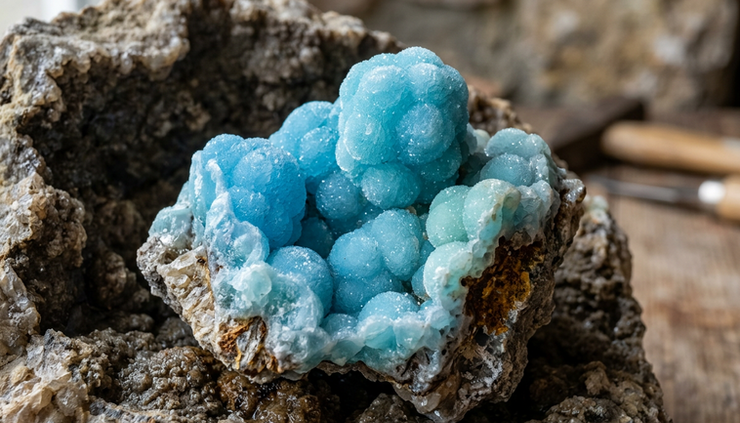
Blue hemimorphite has a look that’s hard to ignore. It can appear powder blue, robin’s egg blue, turquoise-blue, or pale aqua. Some pieces are soft and cloudy. Others look glossy and glassy, like a tropical tide pool decided to become a mineral and stop paying rent.
The blue color often relates to trace elements, especially copper in some specimens, though the exact color can vary based on the stone’s formation conditions and impurities. Pure hemimorphite is often white or colorless, so the beloved blue shades come from nature adding a little seasoning.
The shapes make the color look alive
Hemimorphite doesn’t always form as large, clean, easy-to-see crystals. Many pieces show tiny crystals packed into crusts or rounded masses. Collectors often describe some pieces as “botryoidal,” meaning they look like clusters of grapes. That word comes from the Greek word for grape, which is delightful because geology sometimes sounds like dinner.
Those rounded surfaces can make blue hemimorphite glow in soft layers. Light rolls over the curves instead of bouncing off flat faces. That’s one reason the stone can look gentle rather than flashy.
Common visual forms include:
Botryoidal clusters
Rounded, grape-like surfaces with a soft glow.
Crystal sprays
Tiny crystals that fan outward like frozen fountain water.
Crusts and coatings
Thin layers over another rock, often with rich color.
Stalactitic forms
Drippy-looking mineral growths formed in cavities.
This is why two pieces of hemimorphite can look almost unrelated. One might be milky white and sparkly. Another might be blue and rounded like polished sea glass. A third might be a lumpy little alien landscape. Beautiful? Yes. Consistent? Not exactly. Minerals like to keep us humble.
Where hemimorphite is found
Hemimorphite forms in zinc-rich areas around the world. Not every location produces the same look. Some regions are known for pale crusts, others for vivid blue material, and others for collectible crystal specimens.
Well-known sources include parts of:
The United States, especially zinc mining regions in the Southwest
Mexico
China
Namibia
Belgium
Italy
Greece
That doesn’t mean every stone labeled from one of these places has the same quality or look. Local geology decides the final recipe. Temperature, water, chemistry, surrounding minerals, and time all have a vote. Nature runs the kitchen, and she refuses to write down exact measurements.
The empathy meaning comes from color, feeling, and crystal tradition
Now for the part that makes hemimorphite more than a mineral cabinet beauty.
In crystal traditions, hemimorphite is often associated with empathy, compassion, emotional healing, clear communication, and spiritual light. Those meanings aren’t lab measurements. You can’t put compassion on a scale next to hardness and streak. But symbolic stone meanings have long been shaped by color, texture, history, and how people feel when working with a mineral.
Blue stones are often linked with calm speech and emotional openness. Think of the simple psychology of color. Soft blues tend to feel cooling, spacious, and soothing. That doesn’t mean a blue stone magically solves a hard conversation. It does mean the stone can act as a physical reminder to slow down and choose kinder words.
And honestly, sometimes a reminder is half the battle. A smooth blue stone in your hand can be a lot more useful than telling yourself, “Don’t overreact,” while absolutely overreacting.
Hemimorphite’s spiritual value is best understood as a mindful tool, not a medical treatment. It can support reflection, ritual, and intention, but it shouldn’t replace mental health care, medical care, or practical help when those are needed.
Why people call it the blue stone of empathy
Empathy is the ability to understand or share another person’s feelings. That doesn’t mean absorbing every mood in the room like an emotional sponge with no off switch. Healthy empathy includes boundaries. Hemimorphite’s gentle reputation fits that idea well.
Crystal practitioners often use it when they want to:
Listen with more patience
Speak without sharpness
Release old resentment
Approach conflict with care
Feel emotionally lighter
Stop carrying everyone else’s feelings home like a tote bag full of bricks
The “light” part of its nickname usually points to clarity and uplift. Blue hemimorphite can look airy and luminous, especially in pale specimens. In spiritual language, that brightness gets connected with hope, openness, and emotional release.
Heart and throat symbolism
Many crystal traditions connect blue stones with communication, and green or blue-green stones with the heart. Hemimorphite often sits in that overlap. It’s blue enough to feel linked with speech, and often soft enough in tone to feel emotionally gentle.
That makes it a popular stone for the space between feeling and saying.
You know that weird moment when you know what you feel, but the words come out like a raccoon fell onto a keyboard? Hemimorphite is often used as a reminder to pause before that happens.
People may keep it nearby during:
Journaling
Meditation
Difficult conversations
Apology writing
Grief work
Boundary setting
Creative writing or prayer
Again, the stone doesn’t do the hard part for you. It’s more like a beautiful little cue. It says, “Try honesty, but maybe don’t bring a flamethrower.”

How to use hemimorphite without turning it into a whole production
You don’t need incense, moonlight, a velvet robe, and a playlist of mysterious flute sounds to use hemimorphite. Unless that’s your thing, in which case, live your truth. But the stone works best as a simple focus object.
The goal is to connect a physical object with a mental habit. That’s why worry stones, prayer beads, and keepsakes have existed across cultures for ages. Touch helps attention settle.
Keep it near conversations that matter
If you’re using hemimorphite for empathy or communication, place it somewhere you’ll see it before emotional moments.
Good spots include:
Near a journal
On a bedside table
Beside a quiet reading chair
On a meditation cloth
In a small bowl with other gentle stones
Near handwritten notes or letters
Avoid turning it into a superstition. The stone doesn’t guarantee a perfect conversation. It gives you a pause point. That pause can be powerful.
Try this before sending a hard message:
Hold the stone for a moment.
Take three slow breaths.
Ask, “What am I actually trying to say?”
Remove one sentence that’s only there to win.
Send the clearer version.
Step four is rude but effective.
Use it in a short empathy practice
Here’s a simple practice that takes about two minutes.
Hold hemimorphite in your palm. Notice its temperature, texture, and weight. Let your shoulders drop. Think of someone you’re struggling to understand. Don’t excuse harmful behavior. Just make room for one human truth about them.
You might say silently:
“They may be scared.”
“They may not know how to ask for help.”
“They may be protecting something tender.”
“I can care without losing myself.”
That last one matters. Empathy without boundaries can become self-abandonment wearing a cute hat. Hemimorphite’s gentleness works best when paired with clear limits.
Pair it with journaling
Hemimorphite and journaling make sense together because the stone’s meaning centers on expression. If you don’t know what to write, use prompts.
Try:
What am I feeling that I haven’t said out loud?
Where do I need softer words?
Where do I need stronger boundaries?
Whose emotions am I carrying that aren’t mine?
What would compassion look like if it included me too?
That final prompt is the sneaky one. A lot of people are excellent at offering kindness outward and terrible at allowing any to return. Hemimorphite’s “empathy and light” meaning should include self-empathy. Otherwise, it’s just emotional customer service, and nobody needs that shift.
Use it in a quiet space
A piece of blue hemimorphite can make a calm focal point on a small shelf or table. You can place it near natural textures like wood, linen, stone, or dried flowers. Keep it away from strong sunlight if the color seems delicate, since some minerals can fade or change with long exposure.
You don’t need a complicated setup. One stone, one calm surface, one honest intention. That’s plenty.
How to identify, choose, and care for hemimorphite
Because blue hemimorphite is popular, it’s smart to shop for and care for it with a little practical knowledge. No need to become a full mineral detective, but a magnifying glass and healthy skepticism never hurt. Very classy. Very “tiny Sherlock with a rock habit.”
What to look for when choosing a piece
Good hemimorphite doesn’t have to be deeply colored. Pale blue, white, and blue-green pieces can all be beautiful. Choose based on what you want from it.
For display, look for:
Pleasing shape
Stable matrix, meaning the base rock isn’t crumbling
Interesting crystal texture
Natural color variation
No oily coating or suspicious dye pooling in cracks
For meditation or handling, look for:
Smooth edges
Comfortable size
A stable surface that doesn’t shed grains
A piece you won’t mind touching often
For jewelry, be more careful. Hemimorphite’s hardness makes it vulnerable to scratches and knocks. Pendants and earrings are usually safer than rings because rings take a daily beating. Rings live a rough life. They meet doorknobs, counters, grocery carts, and the occasional dramatic hand gesture.
How to tell hemimorphite from similar stones
Hemimorphite can resemble other blue or blue-green minerals, especially when polished. Color alone isn’t enough to identify it. That’s true for most minerals. Blue is beautiful, but it can also be sneaky.
A few clues can help:
Stone | How it may differ |
Smithsonite | Often has a waxy or pearly look and different chemistry |
Chrysocolla | Usually softer, often more earthy or mixed with green and brown matrix |
Turquoise | Often denser-looking, commonly shows darker webbing or matrix patterns |
Larimar-like stones | Usually show different patterning and formation history |
That table isn’t a substitute for testing by a qualified person. It’s just a starter map. If you’re buying a costly specimen, ask a knowledgeable seller or mineral lab for clear identification. For inexpensive pieces, choose a trusted source and buy what you genuinely enjoy.
How to clean hemimorphite safely
Hemimorphite deserves gentle care. Remember, it’s not super hard, and many specimens have tiny crystals or delicate surfaces.
Use this approach:
Dust with a soft brush.
Wipe polished pieces with a soft cloth dampened with water.
Dry right away.
Store separately from harder stones.
Avoid:
Long soaking
Salt water
Harsh cleaners
Ultrasonic cleaners
Steam cleaning
Scrubbing crystal clusters
Tossing it loose into a bag with quartz or metal objects
If your piece is a delicate cluster, don’t wash it unless you really have to. Dusting is usually enough. Water can loosen fragile areas or leave residue in tiny pockets.

Be careful with water rituals
Some crystal practices involve putting stones in water to make “gem water” or ritual water. Skip that with hemimorphite. It contains zinc, and delicate mineral specimens shouldn't go in drinking water. Even when a stone looks stable, water can interact with surface material, cracks, coatings, or nearby minerals.
If you want the symbolism of water, place hemimorphite beside a glass bowl of water instead of inside it. Symbolic, safe, and no mystery mineral soup. Everyone wins.
How to store it
Store hemimorphite in a padded box, cloth pouch, or separate tray. Keep it away from harder minerals like quartz, topaz, or corundum-family stones. Harder stones can scratch it.
If you have a raw specimen with tiny crystals, give it space. Don’t pile other stones on top. A display case or small stand works well. If the piece is especially fragile, handle it from the base rather than the crystal surface.
Why hemimorphite’s meaning still matters
It’s easy to roll your eyes at crystal meanings if you only look for proof in the laboratory sense. Hemimorphite won’t show up in a scientific paper as a cure for poor communication. Fair enough. Rocks are not therapists with mineral licenses.
But people have always used meaningful objects to shape attention. A wedding ring, a memorial stone, a lucky coin, a handwritten note, a shell from a beach trip none of these objects has to perform magic to matter. They hold memory, intention, and focus.
Hemimorphite’s beauty makes it especially good at that job. Its blue color invites calm. Its soft shine suggests gentleness. Its mineral story connects it to transformation, since it forms when water, air, and time change zinc deposits. That’s a pretty fitting metaphor for emotional growth. Hard things can soften. Buried things can become visible. Pressure and weathering can create something luminous.
That doesn’t mean pain is secretly pretty. Let’s not put a greeting card quote where real life should be. But it does mean change can produce unexpected beauty, and hemimorphite carries that lesson well.
If you use hemimorphite spiritually, let it support practical kindness:
Listen longer than feels convenient.
Tell the truth without sharpening it into a weapon.
Let compassion include boundaries.
Make room for your own feelings.
Choose lightness where you can.
And if you love it purely as a mineral, that’s enough too. You don’t have to meditate with every stone you own. Sometimes “wow, that blue is ridiculous” is a complete spiritual experience.
Hemimorphite earns its nickname as the blue stone of empathy and light because it brings together real mineral beauty and a deeply human idea: we can speak more gently, see more clearly, and carry less heaviness than we did yesterday. Keep it where it reminds you of that. Let it be small, bright proof that softness can still have structure.


Comments