

Mugwort Dreams and Visions: The Witchs Companion

Mugwort is known for appearing at borders such as the edges of a path, sleep, and normal perception. It is a wild plant with silver-green leaves, a bitter smell, and a long record of being regarded as more than merely another roadside herb.
For many witches, traditional practitioners, and people who are interested in plants and dreaming, mugwort is used in work involving transitional states. It should be kept alongside sleep diaries, strolls taken under the light of the moon, threshold charms, and nighttime questions which cannot easily be explained by daytime logic. That said, mugwort should not be idealized carelessly, since it is powerful, complex, and not appropriate for everybody.
This guide looks at mugwort through a practical witchcraft lens: what it is, why it’s linked with visions and visions, how people work with it safely, and how to build a respectful practice around it.

Meet the Herb
Mugwort is Artemisia vulgaris, a tall, silvery-leafed perennial in the daisy family. Its scientific name honors Artemis, the Greek goddess of the wild, the moon, and the hunt, an appropriate patron for an herb so deeply associated with feminine intuition, nighttime visions, and the mysterious.
The plant grows abundantly across the temperate world: Europe, Asia, and now widely naturalized across North America. It's actually one of the most common "weeds" in disturbed ground, roadsides, and old fields throughout the eastern United States. If you've spent time in vacant lots, along train tracks, or in unmaintained corners of urban areas in NJ or NY, you have almost certainly walked past Mugwort many, many times.
The plant is striking once you learn to recognize it:
Height: 3–6 feet tall at maturity
Leaves: Deeply divided, dark green on top, and critically silvery-white and slightly fuzzy on the underside
Stems: Reddish or purple-tinged, often robust
Aroma: Sage-adjacent, herbaceous, slightly bitter, with a distinctive musky depth
Flowers: Small greenish-yellow clusters that appear in late summer
In the apothecary, Mugwort is sold as dried aerial parts, leaves, and flowering tops. Quality Mugwort should have a strong, herbaceous aroma when you crush a bit between your fingers. Old, weak Mugwort barely smells like anything, and won't do the work you're asking of it.
At Rock Collage, you'll find Mugwort in our apothecary herb selection, and it appears in our dream preparations, divination oils, moon rituals, and psychic support blends. It's one of the herbs we recommend most often to customers beginning serious inner work.
Mugwort has always belonged to the thresholds.
Mugwort is commonly known as Artemisia vulgaris, a perennial plant in the aster family. It grows in many temperate regions and often appears in disturbed soil, on roadsides, along field edges, and in backyard corners that no one quite manages to control. In other words, it has strong “I live here now” energy.
The plant has deeply cut leaves, green on top and pale or silvery underneath. When crushed, it gives off a sharp, bitter, herbal smell that some people love and others immediately file under “haunted soup.” That bitterness matters. In traditional herbal systems, bitter plants often have a reputation for waking things up, whether that means digestion, attention, or inner awareness.
Mugwort’s magical associations vary among cultures and traditions, but several themes appear again and again:
Dreams and sleep
Divination and second sight
Protection during travel
Boundary crossing
Lunar magic
Spirit work
Cleansing and uncrossing
Feminine mysteries, especially in older herbals
That last point needs care. Mugwort has a long association with menstrual and reproductive folklore, but that doesn’t mean it’s safe for everyone or appropriate for casual use. Folk tradition and modern safety are not the same thing. If you’re pregnant, trying to become pregnant, nursing, allergic to ragweed or plants in the aster family, taking medications, or managing a health condition, avoid ingesting mugwort unless a qualified clinician says it’s safe for you.
For witchcraft, the good news is simple: you don’t have to ingest mugwort to work with it. Many dream and vision practices use scent, charm-making, smoke, altar work, or symbolic placement. Those methods can be meaningful without treating the plant like a wellness shortcut.
Mugwort’s threshold nature also comes from where it grows. It often appears along paths, fences, abandoned lots, and borders between cultivated and wild space. Folklore tends to notice plants like that. A plant that grows at the edge becomes a plant that helps with edges: waking and sleeping, seen and unseen, known and unknown.
That’s the heart of mugwort magic. It doesn’t force revelation. It sits beside the door and reminds you there is a door.
Mugwort and dream interpretation are a natural pairing.
Mugwort is probably best known in modern witchcraft for its use in dream magic. People tuck it into dream pillows, hang it near the bed, brew it as tea, burn it before sleep, or keep it on an altar dedicated to the moon and memory. The goal is usually some mix of dream recall, clear dreaming, lucid dreaming, or symbolic insight.
That doesn’t mean mugwort guarantees dramatic dreams. Plants are not vending machines. You don’t insert one herb and receive a prophecy by morning. Mugwort works best when paired with steady practice.
If your dream life feels blank, start with the basics:
Keep a notebook within reach.
Write something down as soon as you wake, even if it’s simply a color, mood, or phrase.
Avoid checking your phone first.
Ask one simple question before sleep.
Repeat the same ritual for at least a week.
Mugwort can become part of that rhythm. It acts like a sensory signal to your mind: this is dream time, pay attention.
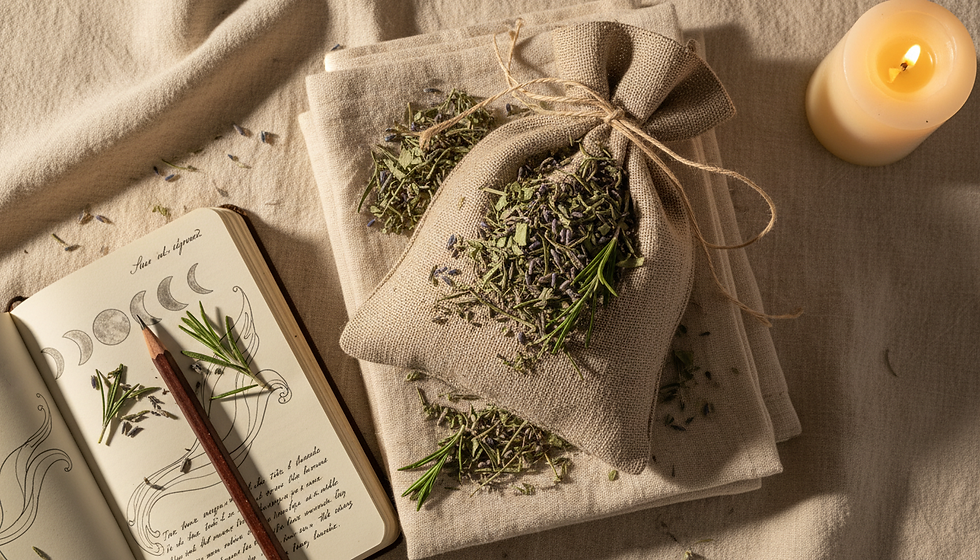
A simple mugwort dream pillow
A dream pillow is one of the gentlest ways to explore mugwort. You’re not eating it, and you can control how much scent you’re near while sleeping.
Use a small cloth pouch and add:
1 part dried mugwort
1 part lavender, if it agrees with you
A pinch of rosemary for memory
A pinch of chamomile, if you want a softer sleep energy
A small piece of paper with your dream question
Keep the pouch near your bed rather than directly under your nose. If the smell is too strong, move it farther away. If you wake with headaches, irritation, or discomfort, stop using it. Your nervous system gets a vote.
Before sleep, hold the pouch and say something plain:
“I ask to remember what is useful, release what is not, and wake with clarity.”
Plain words work. You do not need a poem written in candle smoke unless you enjoy that sort of thing.
Mugwort tea deserves caution.
Mugwort tea appears in many folk practices, but ingestion is where safety matters most. Mugwort can trigger allergic reactions, especially for people sensitive to ragweed, daisies, chrysanthemums, marigolds, or other plants in the aster family. It’s also commonly avoided during pregnancy because of its traditional association with stimulating uterine activity.
This post is informational, not medical advice. If you’re unsure, skip internal use. A dream pillow, charm, foot bath, or altar practice can still give you a strong ritual connection.
If you do choose to drink mugwort tea and you know it’s safe for you, use small amounts and don’t make it a nightly habit. More is not better. With bitter herbs, more often means “now your tea tastes like a warning.”
A dream pillow gives a gentle way to bring mugwort into sleep work.
Mugwort supports vision work without doing the work for you.
When people talk about visions in witchcraft, they may mean many different things. A vision might be a clear inner image during meditation. It might be a symbolic dream that remains with you for years. It might be a sudden realization during divination, or a pattern that becomes obvious after sitting quietly with a question.
Mugwort has a long-standing place in this kind of work because it’s associated with altered attention. Not intoxication, not escapism, and not forcing the mind open. Think of it more as a ritual cue that helps you shift from ordinary task mode into receptive mode.
That shift matters. Most people spend the day solving problems, answering messages, scanning for obligations, and keeping themselves upright in public. Vision work asks for a different state. You need enough structure to feel grounded and enough softness to notice what rises.
Mugwort can help mark that shift.
Setting up a mugwort vision practice
A simple vision practice doesn’t need much. Start with:
Dried mugwort in a bowl or sachet
A candle or low light
A journal
A divination tool, if you use one
An explicit question
Good questions are open but not vague. Try:
“What am I ready to see about this situation?”
“What pattern keeps repeating here?”
“What needs protection right now?”
“What am I avoiding because it feels inconvenient?”
Place the mugwort nearby. If you smoke cleanse and it’s safe in your space, you might burn a small amount before you begin. Keep ventilation in mind; avoid smoke around pets, children, people with asthma, or those with sensitive lungs; and never leave burning herbs unattended. Mugwort smoke can be intense, and “magical atmosphere” loses its charm when the room smells like a scorched field.
Sit quietly for a few minutes. Breathe slowly. Let your eyes soften. If you use tarot, runes, charms, or a pendulum, ask your question and begin.
The point is not to chase spectacle. Good vision work often arrives as a small, clear nudge. A phrase. A body sensation. A memory. A card that makes your gut drop because it’s annoyingly accurate. Write it down before you interpret it too heavily.
Use discernment with visions.
Mugwort’s reputation can make people expect intense experiences. That expectation may lead to over-reading every dream, symbol, or mood shift. A grounded practice gives you room to receive insight without changing every crow, cracked cup, and weird cloud into a full-time assignment.
Try this three-part filter:
Notice
Test
Integrate
What did you dream, see, feel, or hear inwardly? Write it plainly.
Does it connect to real patterns, timing, or past experiences?
What small action, boundary, or reflection follows from it?
If a vision makes you feel panicked, grandiose, or disconnected from daily life, pause the practice and focus on grounding. Eat something. Step outside. Talk to a trusted person. Spiritual work should make you more present in your life, not less.
For anyone with a history of psychosis, mania, dissociation, or severe anxiety, intense vision practices may not be supportive. Choose grounding rituals instead and seek guidance from qualified mental health professionals when required. Witchcraft is allowed to have common sense. In fact, it benefits from it.
Mugwort belongs in the witch’s practical toolkit.
Mugwort is more than a dream herb. In witchcraft, it’s often treated as a consistent companion for protection, divination, cleansing, and threshold rites. That makes it useful across many kinds of practice, from simple home rituals to more formal spellwork.
The key is to match the herb to its job. Mugwort is especially fitting when the work involves perception, boundaries, and passage.
Protection for liminal spaces
Mugwort can be placed near doors, windows, gates, or travel bags as a protective charm. In older folklore, it was sometimes associated with safe travel and warding off harmful influences. Modern practitioners often adapt that into threshold work.
Try making a small bundle with:
Mugwort
Rosemary
Bay leaf
Black thread
A pinch of salt wrapped separately in paper, if salt suits your practice
Hang it near a doorway or place it on an entryway shelf. As you tie it, name the boundary you’re setting:
“Only what is welcome and aligned may enter here.”
If you live with other people, keep strong-scented herbs within shared spaces only if everyone is comfortable with them. Consent is part of good home magic. Nobody should have to wonder why the hallway suddenly smells like a woodland ghost with opinions.
Divination and ritual focus
Mugwort pairs well with divination because it supports attention at the edge of conscious thought. You can keep a small bowl of it beside your tarot deck, charm set, scrying mirror, or pendulum. You might also rub a tiny amount between your fingers before a reading, then wash your hands afterward.
For scrying, place mugwort beside a bowl of water or dark mirror. Ask an explicit question, then gaze softly. Don’t strain your eyes or wait for a full cinematic sequence. Watch for shifts in thought, emotion, and image. If nothing happens, that’s still information. Some nights are for silence.
Moon work and seasonal rites
Mugwort’s lunar associations make it a good fit for full-moon and dark-moon rituals. The full moon can support dream clarity plus divination. The dark moon can support banishing clouded perception, releasing psychic noise, and resting from constant interpretation.
For a simple dark moon ritual:
Place dried mugwort in a small bowl.
Write down one mental pattern you’re ready to release.
Fold the paper away from you.
Set it beside the mugwort overnight.
In the morning, dispose of the paper in a way that fits your practice.
You can compost the mugwort if it’s safe and free of wax, salt, oils, or anything that would harm soil. If you gathered it from outside, be mindful. Mugwort can spread aggressively in some places, so don’t toss roots or seed heads where they can establish unwanted growth.

Build a respectful relationship with mugwort.
A plant can be common and still deserve respect. Mugwort is easy to overlook because it often grows in scrappy places, but that scrappiness is part of its character. It survives. It returns. It doesn’t need ideal conditions to do its work.
If you want mugwort to become part of your practice, move slowly. You’ll learn more from one month of consistent, careful work than from one overloaded ritual where you throw every moon herb into a bowl and hope the universe sorts the filing system.
Source it carefully
You can buy dried mugwort from herb suppliers, grow it in a contained area, or gather it where harvesting is legal and safe. Avoid harvesting near roadsides, sprayed areas, polluted soil, railways, or private property without permission.
If you forage, learn plant identification from more than one source. Mugwort has look-alikes, and confidence should come before harvesting. Pay attention to leaf shape, scent, stem, growth habit, and the pale underside of the leaves. When in doubt, leave it alone.
Take only what you’ll use. Don’t strip a whole patch. If the plant is invasive where you live, responsible harvesting may look different, but you still need to avoid spreading seeds or roots.
Keep a mugwort journal.
Because mugwort is so tied to dreams and visions, journaling is one of the best ways to learn how it affects you.
Track:
Date and moon phase, if you follow lunar timing
How you used mugwort
Amount and form, especially if scent or tea is involved
Dreams or impressions
Mood on waking
Any physical reactions
Later validation or changed understanding
Patterns will start to show. Maybe mugwort makes your dreams vivid but restless. Maybe it improves recall when placed across the room rather than under your pillow. Maybe it works better for divination than sleep. Maybe it doesn’t do much for you, and another plant fits better. That’s not failure. That’s relationship.
Pair mugwort with grounding herbs
Mugwort can feel sharp, airy, or stimulating for some people. If you tend to get overstimulated by dream analysis, pair it with plants that bring steadiness.
Good companions include:
Lavender for calm
Chamomile for softness
Rosemary for memory and protection
Cedar for grounding and purification
Rose for emotional balance
Oatstraw for gentle nourishment, when used appropriately
You can also ground without further herbs. Try a warm drink, clean sheets, a simple meal, a shower, or placing your feet on the floor and naming five ordinary objects in the room. The mystical and the practical are not enemies. They share rent.
Common mugwort correspondences and uses
Correspondences are not fixed laws. They’re a language of association built from folklore, experience, plant traits, and tradition. Use them as a starting point, then improve them through practice.
Correspondence | Common association | Practical use |
Element | Often linked with earth and air | Grounded vision, dream recall, focused perception |
Planetary ties | Often associated with the moon and Venus in modern practice | Lunar rites, intuition, protective charms |
Magical uses | Dreams, divination, protection, cleansing, psychic awareness | Dream pillows, altar bowls, threshold bundles |
Plant quality | Bitter, aromatic, hardy | Boundary work, wakeful attention, ritual transition |
Best placement | Bedside, altar, doorway, travel pouch | Sleep practice, divination, home protection |
Use with caution | Tea, smoke, skin contact for sensitive people | Patch test, ventilate, avoid ingestion when unsure |
Mugwort also works well when assigned a specific ritual role. Instead of asking it to do everything, give it one job.
For example:
In a dream pillow, its job is to support recall.
In a doorway charm, its job is to guard the threshold.
In a divination session, its job is to sharpen perception.
In a release ritual, its job is to help clear confusion.
This kind of clarity makes your practice easier to understand later. If you use nine herbs for eight goals, your journal will read like a soup recipe with moonlight added.

Medicinal Uses
Mugwort has been used medicinally for at least three thousand years across European, Asian, and North American traditions. It's a well-respected herb in Western herbalism, Traditional Chinese Medicine, and various indigenous traditions.
Traditional and contemporary uses include:
Digestive support: Mugwort is a classic bitter tonic that stimulates appetite, supports bile flow, eases bloating, and improves sluggish digestion. Small amounts before meals can be beneficial.
Menstrual regulation: One of the most famous traditional "women's herbs" for regulating menstrual cycles, easing menstrual cramps, and supporting delayed or scanty periods. Because of this action, Mugwort is contraindicated in pregnancy.
Nervous system support: Traditionally used for nervous exhaustion, mild depression, and anxiety, especially when accompanied by digestive complaints or sleep issues.
Sleep support (paradoxically): While Mugwort is famously used to enhance dreaming, it can also help people fall asleep and stay asleep when an anxious or overactive mind disrupts their sleep.
Anti-parasitic: Traditional use for intestinal parasites, related to its Artemisia family relative, Artemisia annua (sweet wormwood).
Moxibustion: In Traditional Chinese Medicine, dried Mugwort (called moxa) is compressed and burned near specific acupuncture points to warm the meridians, move qi, and support healing. This is a specialized practice performed by trained practitioners.
Muscle relaxant: External use as a bath herb or compress for sore muscles.
Immune support: Traditional immune-supportive herb, especially during seasonal transitions.
A note on safety: Mugwort is one of the more medicinally active herbs in this series and requires respect:
Pregnancy: Absolutely avoid during pregnancy. Mugwort is a known emmenagogue and can cause miscarriage. This is not an exaggeration.
Nursing: Avoid during breastfeeding.
Allergies: People with allergies to ragweed, chrysanthemums, and other Asteraceae family plants may react to Mugwort.
Duration: Not intended for long-term daily internal use. Cycles of use (a week on, a week off) are safer than continuous use.
Dose: More is not better. Small amounts are effective; large amounts can cause nausea, vomiting, and neurological effects.
Thujone content: Mugwort contains thujone, the same compound that made absinthe famous. In moderate amounts, it's fine; in large amounts or with prolonged use, it can be neurotoxic.
Medications: Can interact with sedatives, anticoagulants, and some other medications.
Always consult a qualified herbalist or your healthcare provider before using medicinally, especially if you're pregnant, might become pregnant, nursing, on medications, or have any liver or nervous system concerns. Mugwort deserves respect this is not a "sprinkle it in everything" herb.
Mundane & Everyday Uses
Because Mugwort is so widely available (especially in the northeast US where it grows abundantly), its practical daily uses have a long folk tradition:
Dream pillow: A small sachet of dried Mugwort tucked into your pillowcase is the most famous everyday use.
Traveler's aid: The old Roman practice of placing dried Mugwort in your shoes on long walking days is traditional for easing foot fatigue. Whether it works pharmacologically or by placebo, it's still a practice people swear by.
Bath herb: A muslin bag of Mugwort added to bathwater soothes sore muscles and eases nervous tension.
Culinary use (moderate): In some European traditions, Mugwort is used sparingly in cooking, added to fatty meats (especially goose and pork) to aid digestion. This is where its old English name "sailor's tobacco" comes from; it was used to flavor various dishes and drinks.
Beer flavoring (historical): Before hops became the standard, Mugwort was one of the most common bittering herbs in European beer. It's still used in some artisanal and traditional brewing.
Insect repellent: In traditional use, bundles of dried Mugwort are placed in closets and drawers to deter moths and other insects.
Smoke cleansing (household): Bundles of dried Mugwort burned like sage. An important note here: many people use Mugwort as an ethical, easily foraged local alternative to white sage. It's a beautiful practice.
Garden plant: Mugwort grown in the garden is a striking silvery-green presence, though be aware it spreads aggressively. Plant it where you don't mind it taking over, or in a container.
The everyday principle with Mugwort is that it has been part of daily human life for thousands of years, in dozens of small ways. It's not exotic. It's foundational.
Magical & Spiritual Uses
Mugwort is one of the most famous magical herbs in the Western tradition, with a notable presence in many other traditions as well. Its magical uses are broad but interconnected:
Prophetic and lucid dreaming: The most famous magical use. Dried Mugwort in a pillow sachet, burned as incense before sleep, or drunk as a very mild tea before bed is a classic practice for improving dream vividness, improving dream recall, and encouraging prophetic dreams.
Divination: Mugwort is a basic herb for tarot readers, scryers, pendulum workers, and other diviners. Tea sipped before divination, smoke used to cleanse tools, or leaves kept with the divination kit — all traditional.
Psychic development: For people actively developing intuitive and psychic abilities, Mugwort is one of the most-recommended herbs to work with over time.
Astral projection and dream travel: In more advanced practices, Mugwort is used to support conscious exploration of dream states, astral travel, and journeying.
Moon magic: Deeply associated with the moon, especially the waxing and full moon phases. Used in lunar rituals, moon water preparations, and workings connected to feminine cycles.
Protection while traveling (physical and spiritual): From the Roman shoe tradition to current travel amulets, Mugwort is considered a protective ally for journeys of all kinds.
Smoke cleansing: Bundled and burned like sage for space clearing, tool cleansing, and personal energetic maintenance, and considered a more eco-friendly and often more locally connected alternative to white sage.
Preparation for ritual work: Used to prepare the practitioner (and the space) before serious ritual, meditation, or trance work.
Ancestor communication: In some traditions, used to establish channels of communication with ancestors, especially through dreams.
Its correspondences across traditions:
Element: Air (mental clarity, communication, spirit) with strong Water (dreams, emotion, intuition) associations
Planet: Moon (dreams, intuition, cycles); this is Mugwort's primary planetary rulership across nearly all Western traditions.
Day: Monday (Moon)
Zodiac: Cancer (Moon rulership, intuition) with Pisces associations (dreams, mysticism)
Deities: Artemis (Greek), Diana (Roman), Selene (moon goddess), Hecate (in some traditions)
Intention: Dreams, prophecy, divination, psychic development, moon work, protection while traveling, cleansing, feminine intuition
Classic magical practices:
The Dream Pillow: Small cloth sachet filled with dried Mugwort (sometimes with lavender for gentleness, mint for clarity, and a small clear quartz or amethyst crystal) and placed under or inside the pillow before sleep.
The Divination Wash: Weak Mugwort tea used to cleanse a scrying mirror, crystal ball, tarot deck, or pendulum before use.
The Third Eye Anointing: A single drop of Mugwort oil (properly diluted) touched to the third eye before meditation or divination.
The Moon Bath: A bath with Mugwort taken on the night of a full moon to coincide with lunar energy and receive intuitive downloads.
The Mugwort Bundle: Dried Mugwort stems bundled with cotton thread and used as smoke cleansing wands for regular space clearing.
A note on Mugwort and modern trends: Mugwort has become extremely popular in contemporary witchcraft, particularly on social media. This has led to some overuse and casual use that doesn't always respect the herb's actual power. A few reminders:
Mugwort is genuinely psychoactive at higher doses. Not dangerously or dramatically at normal use levels, but its effects are real. Start small.
Dreams can become intense with regular Mugwort use. This is usually good but not always. If you're processing trauma or deep grief, be thoughtful about intensifying that dream space.
Not everyone responds to Mugwort the same way. Some people have vivid dreams immediately; others need steady practice; some are more affected by its energetic quality than its dream-inducing quality.
Mugwort is generally a "companion" herb rather than a "quick fix" it rewards an ongoing relationship more than one-time use.
5. How to Forage & Identify
Excellent news: Mugwort is one of the most abundantly available foraging herbs in the entire Northeast United States. It grows aggressively along roadsides, in vacant lots, in city parks, along railroad tracks, in disturbed soil, and in essentially any unmaintained corner of the region. If you're in North Jersey, you don't need to buy Mugwort — you almost certainly have Mugwort growing within a mile of your home.
Key identifying features:
Growth habit: Tall (3–6 feet), upright, often reddish-purple stems with branching upper portions.
Leaves: Deeply lobed and pinnately divided (think of an oak leaf's general shape but more delicate and feathery). Alternately arranged on the stem.
The critical identifier: Turn a leaf over. The underside is distinctly silvery-white and slightly woolly/fuzzy. The top is dark green. This two-tone quality is Mugwort's signature.
Aroma: Crush a leaf. This scent is unmistakable sage-adjacent, herbaceous, slightly bitter, musky, and distinctly deep. Once you know it, you'll know it forever.
Flowers: Small, greenish-yellow, in clusters at the tops of stems in late summer (August–October). Not showy — you might miss them if you weren't looking.
Root system: Aggressive rhizomatous spread. One Mugwort plant quickly becomes a Mugwort patch.
Habitat: Disturbed ground. Sunny to partially shaded areas. Poor soil is fine; Mugwort thrives where many plants struggle.
Harvesting tips:
Best time: Mid to late summer, ideally on a sunny morning after the dew has dried. Some traditional practitioners specifically harvest around the summer solstice or a full moon in July or August.
What to take: The upper 1/3 of the plant leaves and flowering tops. Cut with scissors or clippers.
Sustainability: Mugwort is abundant and often considered invasive. Harvest freely from wild patches without concern for depleting populations.
Location: AVOID harvesting from places treated with pesticides, herbicides, or fertilizers. Avoid roadsides where car exhaust settles on plants. Avoid areas of possible soil contamination (former industrial sites, rail yards, etc.). Look for Mugwort in clean parks, natural areas, backyards, and rural fields.
Drying: Hang bundles upside down in a warm, dark, well-ventilated area for 2–3 weeks. Alternatively, spread on screens in single layers. Store when completely dry.
Lookalikes: Mugwort is fairly distinctive, but a few plants can look similar at a glance:
Common Ragweed (Ambrosia artemisiifolia): Similar deeply lobed leaves and similar height, but ragweed leaves are green on both sides, with no silvery underside. Also lacks Mugwort's characteristic aroma. Important not to confuse due to ragweed allergies.
Wormwood (Artemisia absinthium): A close relative and also useful medicinally, but with more silvery-gray leaves overall (not just underside) and a more intense bitter aroma. Not commonly wild in NJ.
Wild Chrysanthemum and other Asteraceae: Different leaf shape, different scent.
When in doubt, don't harvest. The fragrance test (crush the leaf and smell) and the underside test (silver-white, fuzzy underside) together will confirm Mugwort with near certainty.
🌿 NJ & Northeast Reader Tip: Mugwort is one of the great gifts of North Jersey foraging. It grows abundantly throughout the state, in fact, so much so that it's considered an invasive species in many areas. Every unmaintained corner of Bergen, Passaic, Hudson, and Essex counties has Mugwort. Look for it: Along the edges of parks (Overpeck Park, Van Saun Park, Branch Brook Park) Along the Palisades hiking trails (in the sunnier open areas) In vacant lots throughout urban NJ Along railroad rights-of-way (view from a safe distance don't harvest near active tracks) In old farm fields and pasture edges in western NJ In your own yard, probably, if you don't mow religiously Peak harvest season in NJ is mid-July through early September. Safety note: Because Mugwort grows so aggressively in disturbed urban environments, be extra thoughtful about where you harvest. Choose parks and clean natural areas, not lots that may have been contaminated with industrial residue, and never harvest from roadsides where car exhaust settles on plants. If you'd rather not forage, high-quality dried Mugwort is available at herb shops, spiritual supply stores, and (occasionally) at Asian markets. Chinese and Korean grocery stores sometimes carry dried Mugwort for traditional medicinal and culinary purposes. For Teaneck-area readers: you can pick up top-quality dried Mugwort, house-made dream pillows, divination oils, moon ritual supplies, and Mugwort smoke cleansing bundles at Rock Collage, 441B Cedar Lane, Teaneck, NJ. We source Mugwort with the intention behind it for real dream work, real divination, real inner sight.
Simple Ways to Work With It This Week
Mugwort rewards patient, ongoing practice more than one-time dramatic use. Try one of these:
😴 A Classic Dream Pillow
Fill a small cotton or muslin pouch with a mix of dried Mugwort, dried lavender (for gentleness; Mugwort can be intense), and a small clear quartz or amethyst crystal. Sew or tie closed.
Place inside your pillowcase, or on your nightstand within reach.
Before sleep, squeeze the pillow gently and inhale. Set an intention: "I welcome the dreams I need. I remember what I'm shown. I awake with clarity."
Keep a dream journal by the bed. Write down whatever you remember first thing in the morning, before checking your phone. Even fragments count.
Refresh the Mugwort every 2–3 months, or when the scent fades.
🔮 A Divination Preparation Ritual
Before a tarot reading, oracle session, scrying, or any divinatory practice:
Brew a very mild Mugwort tea 1/2 teaspoon of dried Mugwort in a cup of hot water, steeped for 5 minutes. Strain. Do NOT make it stronger. Add a small amount of honey.
Sip slowly while you shuffle your cards, prepare your space, or ground yourself. As you sip, invite the vision:
"Let me see clearly. Let me hear what wants to be heard. Let me speak only what I'm meant to speak."
Alternative for those who don't want to drink Mugwort: pass your tarot deck, crystal ball, or pendulum through Mugwort smoke to cleanse and consecrate it before use.
🌙 A Full Moon Ritual Bath
On the night of a full moon (or the night just before), draw a bath. Add a muslin bag containing 2 tablespoons of dried Mugwort. Add a cup of Epsom salt and, if you have them, a small handful of dried rose petals or lavender.
Turn off the electric lights. Light candles instead. Enter the water.
As you soak, look at the moon (if you can see it from your bathroom) or feel the moon's energy present in the water. Ask the moon whatever question is heavy on your heart. Listen.
Say: "I receive what the moon shows me. I release what no longer serves. I align with my own knowing."
Best done monthly at the full moon for sustained intuitive development.
🌿 A Mugwort Smoke Cleansing Bundle
If you grow or forage your own Mugwort, gather 8–10 fresh stems about 8–10 inches long. Tie them tightly with cotton string, starting at the base and wrapping upward in a spiral pattern. Wrap tightly — the bundle will shrink as it dries.
Hang upside down in a warm, dark, well-ventilated space for 2–3 weeks until completely dry.
To use: light one end, blow out the flame so it smolders, and use the smoke to cleanse your space. Move room to room, focusing on corners, doorways, and any places that feel energetically stagnant.
This is a beautiful, sustainable local alternative to white sage, with the added benefit of being deeply connected to the European and North American folk traditions of this region.
🎨 A Third Eye Anointing
Take about a tablespoon of your favorite carrier oil (jojoba, almond, or olive) into a small clean container. Add 2–3 crushed dried Mugwort leaves. Let sit for a week, then strain.
Before divination, meditation, or work: touch: dip a fingertip in this oil and touch it gently to the space between your eyebrows (the third eye).
Say: "I open my inner sight. Observe." See."
📖 A Sustained Dream Practice
The most powerful way to work with Mugwort isn't dramatic; it's consistent. Try this for one lunar cycle:
Keep a dream journal by your bed.
Place a small Mugwort sachet in your pillowcase.
Every night, before sleep, spend 30 seconds setting the intention: "I remember my dreams tonight."
Every morning, before doing anything else, write down whatever fragments you remember.
After 4 weeks, review your dream journal.
Most people find that after 2–3 weeks of sustained practice, their dream recall dramatically improves. Patterns emerge. Messages become clearer. This is Mugwort's slow, patient magic.
⚠️ A Note on Mugwort and Trauma
If you're actively processing trauma, deep grief, or recent significant loss, be thoughtful about intensifying your dream life right now. Mugwort can bring buried material to the surface, which is powerful but can also be overwhelming.
If you use Mugwort during difficult times, do so in the context of therapy, spiritual support, or other resources. Consider gentler dream herbs (lavender, chamomile, mullein) if your system needs more softness right now.
FAQ
Can mugwort really cause vivid dreams?
Many people report more vivid dreams or better dream recall when working with mugwort, especially through scent or bedtime ritual. That said, answers differ. The ritual around the plant, including journaling and intention, often matters as much as the herb itself.
Is it safe to sleep with mugwort under my pillow?
For many people, a small sachet near the bed is more comfortable than placing it directly under the pillow. Avoid it if you have allergies to mugwort, ragweed, or related plants. Stop using it if you notice headaches, skin irritation, breathing discomfort, or restless sleep.
Can I burn mugwort as incense?
You can burn dried mugwort in small amounts if smoke is safe for your space. Use a fireproof dish, ventilate well, and keep it away from pets, children, and sensitive lungs. Never leave burning herbs unattended.
Who should avoid mugwort?
People who are pregnant, trying to become pregnant, or nursing are commonly advised to avoid mugwort, especially internally. People with allergies to plants in the aster family should also be cautious. If you take medication or have a health condition, check with a qualified clinician before ingesting it.
What can I use instead of mugwort for dream magic?
Lavender, chamomile, rosemary, rose, and lemon balm are common alternatives, depending on your needs and sensitivities. For a non-herbal option, use a dream journal, a glass of water by the bed, a moon image, or a small stone dedicated to dream recall.
A clear ritual space helps mugwort work stay grounded and focused.
Let mugwort be a companion, not a shortcut.
Mugwort is an effective partner for dream practice, vision practice, and threshold magic, but it doesn’t replace discernment. It won’t hand you instant wisdom, and it won’t make every dream prophetic. What it can do is help you build a ritual container where memory, symbol, and intuition have room to speak.
Start small. Use a dream pillow before tea. Try an altar bowl before smoke. Keep notes. Watch your body’s responses. Treat the plant like a relationship rather than a tool you grab only when you want answers.
The best work with mugwort is steady, respectful, and grounded. Meet it at the edge of sleep, ask a distinct question, and keep a pen nearby. The message may be subtle, but subtle doesn’t mean weak. Sometimes it’s the quiet image you write down at 6:12 a.m. that changes how the whole day looks.
Every serious apothecary needs Mugwort. Not because it's fashionable, though it is, and has been trending across witchcraft social media for years now, but because for as long as humans have been looking for insight beyond the obvious, Mugwort has been one of our most reliable guides. Roman legionaries put it in their sandals to protect against fatigue on long marches. Anglo-Saxon healers included it in the Nine Herbs Charm as one of the most powerful healing plants known. Chinese medicine has used it in moxibustion for over two thousand years. And every witch, seer, dreamer, and diviner who has ever wanted their vision to open a little wider has reached for Mugwort at some point.
This is the herb of the threshold, the plant that stands at the border between waking and sleeping, between conscious and unconscious, between the world you can see with your eyes and the world you can only see with everything else. If you've been feeling like your intuition needs a boost, your dreams need more depth, or your inner sight needs to open, Mugwort is the companion.
Closing Thoughts
Mugwort is the herb of the threshold. It stands at the edge between what you know consciously and what you know underneath the intuition, the dreams, the visions, the gut sense that has been trying to tell you something.
In a world that trains us to trust only what we can measure and prove, Mugwort is a quiet rebellion. It insists that the dream world is real. That the gut knows things the mind doesn't. That the moon has something to say. That the space between waking and sleeping is a doorway, not a dead zone.
If you've been feeling like your intuition has been muffled, your dreams have been thin, or your inner sight has been closed, Mugwort is the herb that gently opens those doors. Not all at once. Not dramatically. But steadily, over time, in relationship as this plant has always taught its practitioners.
Artemis's plant is still here. She's still teaching. And she's ready when you are.
Ready to work with Mugwort? Visit Rock Collage at 441B Cedar Lane, Teaneck, NJ, or shop online at rockcollage.com.


Comments